Modern system-on-chips (SoCs) are no longer built around a single clock and a single reset. Today’s designs integrate hundreds of IP blocks, multiple power domains, software-controlled reset sequences, and sophisticated power-management techniques. While these advancements have enabled remarkable functionality and performance, they have also introduced new verification challenges—one of the most significant being reset domain crossing (RDC) verification. RDC verification has become an essential part of design sign-off because it identifies situations where different reset domains interact in ways that may lead to metastability or functional failures. However, as SoCs continue to grow in complexity, another challenge has become increasingly apparent: verification noise. Many engineering teams spend more time investigating RDC violations that are actually safe than fixing genuine design issues. The question is no longer simply, “Can we detect RDC violations?” The more important question is, “Can we distinguish genuine design risks from safe implementation choices?” Why conventional RDC verification produces so many violations Traditional RDC verification relies primarily on structural analysis. If two sequential elements belong to different reset domains, the crossing is reported as a potential RDC violation. From a safety perspective, this conservative approach is justified. Different reset domains may assert or de-assert independently, potentially allowing unstable values to propagate through the design. Reporting every possible interaction minimizes the likelihood of missing a genuine bug. The limitation, however, is that structural analysis alone does not capture the designer’s intent. Today’s SoCs often employ sophisticated reset architectures involving reset controllers, synchronized reset generation, staged initialization sequences, and software-controlled resets. These mechanisms intentionally create multiple reset domains while still ensuring correct functional behavior. Consequently, many structurally different reset crossings do not present any real metastability risk. Yet conventional RDC analysis reports them all as violations, leaving engineers to manually separate true failures from safe implementations. For large designs, this often results in thousands—or even tens of thousands—of reported violations, significantly increasing debug effort and slowing verification closure. Different reset domains do not always mean different risks One of the most common misconceptions in RDC verification is assuming that different reset domains automatically imply metastability. In reality, the safety of a crossing depends on
how resets are generated and how they interact with the clock, not simply on whether two registers belong to different reset domains. Consider a design in which both the transmitter (Tx) and receiver (Rx) registers operate on the same clock but belong to different asynchronous reset domains. At first glance, this appears to be a typical RDC violation. Now consider that the transmitter reset is itself generated synchronously within that clock domain using a reset-generation register. Because the reset transition is synchronized to the clock, any reset-induced transition at the transmitter occurs only on a clock edge. Consequently, the receiver also observes only clock-aligned transitions. In this situation, the crossing behaves as a conventional synchronous timing path rather than an asynchronous RDC hazard. If static timing analysis (STA) confirms that setup and hold requirements are satisfied, the implementation is functionally safe. Structurally, the path appears to cross different reset domains. Functionally, it behaves like a correctly timed synchronous path. Nevertheless, conventional RDC verification continues to report it as a violation because it considers only reset-domain differences rather than the underlying design behavior. Figure 1 illustrates the difference between conventional structural RDC analysis and the proposed STA-aware methodology. Instead of reporting every reset-domain crossing as a functional violation, the enhanced flow identifies crossings that are timing-safe and classifies them separately for STA validation.
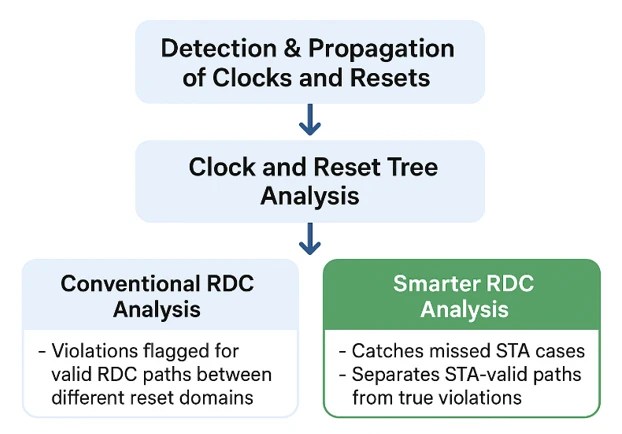 Fig. 1: Flow of RDC analysis.
 The same principle applies to other RDC scenarios This concept extends beyond crossings between asynchronous reset domains. For example, designers frequently encounter crossings where the transmitter belongs to an asynchronous reset domain while the receiver has no reset at all. Conventional RDC tools classify these paths as violations because a non-resettable register effectively belongs to its own reset domain. However, if the transmitter reset is generated synchronously within the same clock domain, the receiver still observes only clock-synchronous transitions. In this case, timing—not reset behavior—determines correctness. Another common example involves crossings from an asynchronous reset domain to a synchronous reset domain. Structural analysis reports these as potential RDC violations because the reset types differ. In practice, if reset sequencing guarantees that the receiver is already held in reset whenever the transmitter resets, and STA validates the timing path, the crossing does not introduce a functional RDC hazard. Bringing context into RDC verification Instead of asking only whether two registers belong to different reset domains, context-aware RDC verification asks a more meaningful question: Does this crossing actually create a metastability risk, or is it simply a timing path that should be validated through STA? This seemingly small shift fundamentally changes the verification process. Rather than reporting every structurally different reset interaction as a violation, the verification flow evaluates additional design context, including:
- How the reset is generated
- Whether the reset source is synchronous to the operating clock
- Whether the transmitter and receiver share the same clock domain
- Whether the path can be safely validated through STA
When these conditions indicate that the crossing is functionally safe, the path is no longer reported as a functional RDC violation. Instead, it is classified as an
STA-aware caution, indicating that the crossing requires timing validation rather than RDC debugging. This additional context allows engineers to focus on genuine functional issues while ensuring that timing-related paths are still verified through the appropriate analysis methodology. Better classification—not fewer checks A common misconception is that reducing reported violations means relaxing verification. That is not the objective. The goal is
better classification. True RDC hazards continue to be reported exactly as before. Only crossings that can be demonstrated to be timing-safe through reset behavior and design context are separated from genuine functional RDC failures. This distinction enables verification engineers to prioritize their efforts more effectively by distinguishing between:
- Genuine RDC failures requiring functional investigation
- Timing-safe crossings requiring STA validation
- Safe implementation choices that do not require further RDC debugging
This methodology reduces false positives without compromising verification quality or sign-off confidence. Measuring the impact To evaluate this methodology, it was applied to a large industrial design containing nearly 296,000 register bits, multiple memories, and several latch-based elements. Conventional RDC verification reported approximately 50,000 RDC violations. A significant portion of these represented crossings that were structurally different but functionally safe. By incorporating STA-aware classification, approximately 10,000 crossings were automatically identified as timing-safe and reclassified as cautions instead of violations. The resulting improvements included:
Metric Result Total reported RDC violations ~50,000 Crossings reclassified as STA-aware cautions ~10,000 Reduction in reported violations Nearly 20% False positives Significantly reduced Verification closure Faster debug and improved productivity Most importantly, all genuine RDC hazards remained visible throughout the verification process. The methodology reduced verification noise—not verification quality. Looking ahead Simply identifying every possible reset interaction is no longer sufficient. Verification tools must also understand the design context and distinguish structural differences from genuine functional risks. By combining traditional RDC analysis with timing awareness and context-based classification, engineers can significantly reduce false positives while maintaining the confidence required for silicon sign-off. The result is not fewer checks, but more meaningful insights—allowing engineering teams to focus their time on solving real design problems instead of investigating safe reset crossings. To learn more about the methodology, kindly download the full paper
Refining RDC to catch missed STA scenarios. The post
Separating The Chaff From The Wheat: Focusing On Only The RDC Violations You Care About appeared first on
Semiconductor Engineering.
Source:
https://semiengineering.com/separating- ... are-about/